
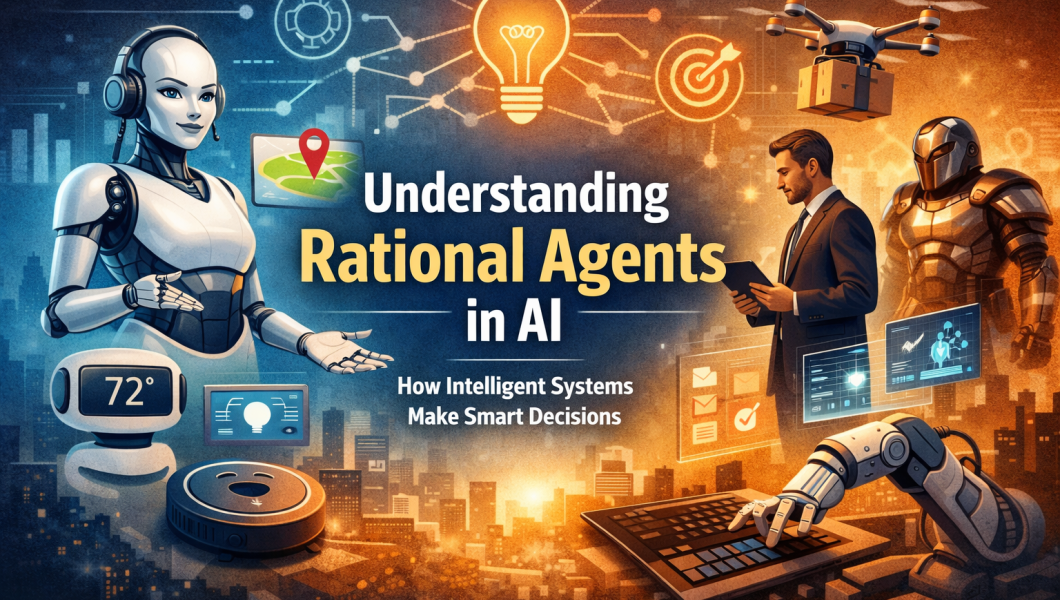
Have you ever wondered why you make certain choices every day? When you wake up, you decide what to wear, what to eat for breakfast, or how to get to school or work. You check the weather and decide to grab an umbrella. These decisions might feel small, but they show how your brain uses information from the world around you to pick the best possible action. In artificial intelligence (AI), there is a similar idea called a *rational agent*. A rational agent is an AI system that always tries to do the right thing based on its goals and what it knows about the world. This article explains rational agents in a way that is easy to understand and shows how they are used in real life.
What Is a Rational Agent?
A rational agent is a computer program or machine that looks at the world and makes smart decisions to achieve its goals. The word rational means that the agent tries to choose the best action possible. To decide what to do, the agent gathers information (called percepts) from its surroundings, thinks about its goals and what it already knows, and then acts in a way that it believes will lead to success. In simple terms, a rational agent uses what it sees to make the best choice.
Imagine a robot vacuum cleaner. Its goal is to keep the floor clean. It has sensors to detect dirt and obstacles, and it can move around the room. When the robot sees dirt under the couch, it goes there to clean it. It avoids bumping into walls and furniture because it senses them. If the battery is low, it returns to its charging station. This robot acts like a rational agent: it perceives its environment and chooses actions that will lead to a clean floor, which is its goal.
Why Do Rational Agents Matter?
Rational agents are important because they help machines and computer programs behave in ways that benefit people. They allow AI systems to act intelligently, solve problems, and provide help in areas like customer service, education, healthcare, and business. When a chatbot answers a question on a website, it is acting like a rational agent by listening to your question, looking up the best answer, and responding in a helpful way. When your car’s navigation system suggests the quickest route to a destination, it is behaving like a rational agent by using traffic data to choose the best path.
Understanding rational agents helps us build better AI systems. If we know how to create agents that think carefully and act wisely, we can use them to make tasks easier for people and improve their lives. Whether it’s a smart home device that adjusts the temperature for comfort, or a business automation system that handles routine tasks, rational agents make AI more useful and reliable.
How Do Rational Agents Work?
To understand how rational agents work, let’s break down the key parts:
1. Percepts (Seeing the World):A rational agent takes in information from its environment using sensors or inputs. For a robot vacuum, these sensors detect dirt and obstacles. For a virtual assistant like an AI chatbot, the percept might be your text or voice message.
2. Knowledge and Goals (Thinking and Planning):The agent has goals it wants to achieve and knowledge about how the world works. The robot vacuum knows its goal is to clean, and it understands that furniture blocks its path. The chatbot’s goal is to provide helpful answers, and it knows facts or instructions to help you.
3. Actions (Doing Something):Based on what it sees and knows, the agent chooses an action. The robot vacuum might turn left to avoid a chair. The chatbot might choose to reply with specific information. The actions are the steps the agent takes to achieve its goal.
4. Performance Measure (Judging Success):The agent also uses a way to measure how well it is doing. For the robot vacuum, success is measured by how clean the floor is. For a delivery drone, success might be measured by how quickly and safely it delivers packages. This measure guides the agent’s decisions.
By combining these steps, a rational agent constantly looks at its surroundings, makes choices, and acts in ways that move it closer to its goals.
Real‑World Examples of Rational Agents
Rational agents are not just robots in science fiction. They are all around us, helping in everyday life and business. Here are some real‑life examples:
- Navigation Systems: When you use a GPS app to find directions, it acts like a rational agent. It knows your destination (goal), looks at your current location and road conditions (percepts), uses map data and traffic information (knowledge), and suggests the best route (action) to get you there quickly.
- Chatbots and Virtual Assistants: Many websites use chatbots to answer customer questions. These AI assistants listen to what people ask (percepts), search through a database of answers and information (knowledge), and respond in a helpful way (action). They aim to solve problems or provide support as quickly as possible (goal).
- Smart Thermostats: A smart thermostat senses the temperature in your home (percepts) and adjusts heating or cooling (action) to keep you comfortable. It knows your preferred temperature settings (knowledge) and tries to maintain that comfort while saving energy (goal).
- Automated Customer Service Agents:In business, AI agents help process orders, handle emails, and even follow up on leads. They read incoming messages or data (percepts), understand what people need (knowledge), and act by sending emails, scheduling meetings, or entering data into a system (actions). Their goal is to support customers efficiently.
- Game Characters: In video games, computer‑controlled characters often act like rational agents. They look at the game environment (percepts), decide how to react to players or obstacles (knowledge and goals), and take actions such as moving, hiding, or attacking to reach their goals.
- Business Workflow Automation: At AutomizeHub.ai, rational agents power automation workflows that handle repetitive tasks like sorting emails, updating records, and scheduling follow‑ups. They perceive incoming requests or data, decide what action is needed, and execute that action. This frees up human workers to focus on more creative and strategic tasks.
These example
easier by using information and logic to choose the best actions.
Rational Agents vs. Other Types of Agents
Not all AI systems work the same way. It is helpful to know how rational agents are different from other types of agents:
– Simple Reflex Agents: These agents act only on the current input, without planning or thinking about the future. They do not store any memory of past events. A basic thermostat that turns on the heater when the room is cold and turns it off when it’s warm is a simple reflex agent. It does not plan or think ahead; it just reacts.
– Model‑Based Reflex Agents: These agents keep some memory of the past and use it to make better decisions. A robot vacuum that remembers where it has already cleaned can avoid going over the same spot again. It uses a simple internal model of the world to plan its actions.
– Goal‑Based Agents: These agents, like rational agents, have goals and take actions to achieve them. They consider different possible actions and choose those that move them closer to their goals. Rational agents are often goal‑based agents with a clear way to measure success.
– Learning Agents: Some agents can improve over time by learning from their experiences. A learning agent might start with simple strategies and, through practice, figure out better ways to achieve its goals. For example, an AI assistant that gets better at answering questions as it interacts with more users is a learning agent.
Rational agents can include learning and goal‑based elements. The key point is that they try to take the best possible action according to their understanding of the world and their goals.
Benefits of Rational Agents for Businesses
Businesses of all sizes are using rational agents to improve efficiency and provide better service. Here are some advantages:
- Time Savings: Rational agents handle routine tasks quickly and accurately. Automated email responses, appointment scheduling, and data entry can be done without human intervention, freeing people to focus on more complex and creative work.
- Improved Accuracy: Machines do not get tired or distracted. Rational agents follow set rules and use data correctly, which reduces mistakes and ensures tasks are completed consistently.
- 24/7 Availability: AI systems can work at any time of day. This means customers can get help and services even outside of regular business hours. For example, a chatbot can answer questions on a website at midnight, helping users right away.
- Better Decision Making: Rational agents analyze data and choose actions based on facts and goals. In marketing, for instance, an AI agent might examine customer behavior and suggest the best time to send a promotional email.
- Scalability: As a business grows, rational agents can handle more tasks without needing extra people. They can be set up to manage new processes and high volumes of work.
By using rational agents, companies can improve service quality, reduce costs, and operate more efficiently..
This leads to higher customer satisfaction and more time for human employees to focus on new ideas.
How AutomizeHub.ai Uses Rational Agents
At AutomizeHub.ai, we believe in using AI to solve real problems. Our team specializes in building intelligent agents that make life easier for businesses. We follow a problem‑first approach: first we understand the problem a business faces, then we design AI agents that can help. Here’s how we apply the concept of rational agents:
– Custom AI Solutions: We work closely with clients to understand their goals and challenges. Then we build AI agents that perceive data from systems like CRMs and websites, think about the best actions to meet the clients’ goals, and act by automating tasks. If you want to explore more of our services, see our dedicated [Services](/services) page for details.
– Smart Workflow Automation:We create automated workflows that read incoming requests, such as contact form submissions or support tickets, and decide what actions to take. For example, if a customer submits a request, the agent might respond with information or schedule a meeting automatically. These workflows save time and improve accuracy.
– Friendly AI Chatbots: Our chatbots are rational agents that answer questions on websites and messaging platforms. They listen to what users ask, search for the best answers, and respond in a helpful way. They help businesses provide instant support and collect valuable feedback.
– Continuous Improvement:We build agents that learn over time. They collect data on how well they are performing and use it to make better decisions in the future. This means your AI system keeps getting smarter and more efficient.
By focusing on real problems and practical solutions, AutomizeHub.ai makes rational agents work for you. Explore our other blog posts on our [blog](/blog) to see more examples and insights about AI agents and automation.
Adding Human Emotion to AI
Even though rational agents are machines, we can design them to interact in a way that feels warm and human. For example:
– Empathetic Responses: A customer support chatbot can be programmed to respond kindly when a user is frustrated. It can say, “I’m sorry that you’re having trouble,” before providing a solution. This small touch can make people feel heard and valued.
– Friendly Language: Instead of using technical jargon, we train our agents to use simple, friendly language. Just like this article, the agents communicate in a way that is easy to understand.
– Personalization: A rational agent can address a user by their name and remember past interactions. This makes the conversation feel personal and builds trust.

By designing AI agents with human emotion in mind, businesses can provide helpful services that also feel caring and approachable.
Conclusion
Rational agents are a key idea in artificial intelligence. They collect information from the world, think about what they want to achieve, and choose the best actions to reach their goals. You see rational agents at work when a chatbot answers your questions, when a GPS guides you through traffic, or when a smart thermostat keeps your home comfortable.
For businesses, rational agents offer many advantages. They save time, improve accuracy, and provide round‑the‑clock service. At AutomizeHub.ai, we use rational agents to create custom AI solutions that help companies run more smoothly. Our problem‑first approach means we listen to your needs and build intelligent systems that work for you.
If you’re curious to learn more about how AI can transform your business, read our other blog posts or explore the services page to see how we help companies with AI solutions. Rational agents aren’t just a technical concept. They are a powerful tool for helping people and businesses thrive. With thoughtful design and a human touch, AI can make the world more efficient, caring, and connected.






No Comments